
Damage type guide · Frame and structural damage
How to tell if a car has frame damage
Check for uneven panel gaps, doors or a trunk lid that close badly, uneven tire wear or pulling, overspray or fresh sealer on structural seams, and weld or clamp marks underneath. Those are clues; none of them proves it. An inspection on a lift, a measuring printout and the repair invoice tell you far more, and a clean history report does not rule frame damage out.


By the Autoloss team · Reviewed by Monica Fisher · Published
This guide is for two readers: an owner whose car has just been repaired after a collision, and someone deciding whether to buy a used vehicle. The checks are the same. What differs is what you can ask for afterward.
Clues you can check in daylight
- Panel gaps. Look at the spacing between the hood and the fenders, the doors and the pillars, and the trunk lid and the quarter panels. Compare left with right. Gaps that taper, or that are wide on one side and tight on the other, suggest something moved.
- Doors, hood and trunk. A door that has to be slammed, drops as it opens or rubs the striker, and a hood or trunk lid that sits high on one corner, are worth a closer look.
- Paint in odd places. Overspray on rubber seals, wiring or hoses in the engine bay, or a color difference on the aprons or inside the door jambs, means areas that are normally left alone were refinished.
- Seams and sealer. Factory seam sealer is neat and even from side to side. Sealer that looks brushed on, lumpy or different on one side often marks a replaced panel.
- Weld marks. Factory spot welds leave rows of small, regular dimples. Repair welds tend to look like larger round plug welds or a continuous bead.
- Tool marks on bolts. Scratched bolt heads on the fenders, hood hinges or radiator support show parts were removed. That alone points to bolt-on work, but it tells you where to look harder.
Underneath and on a test drive
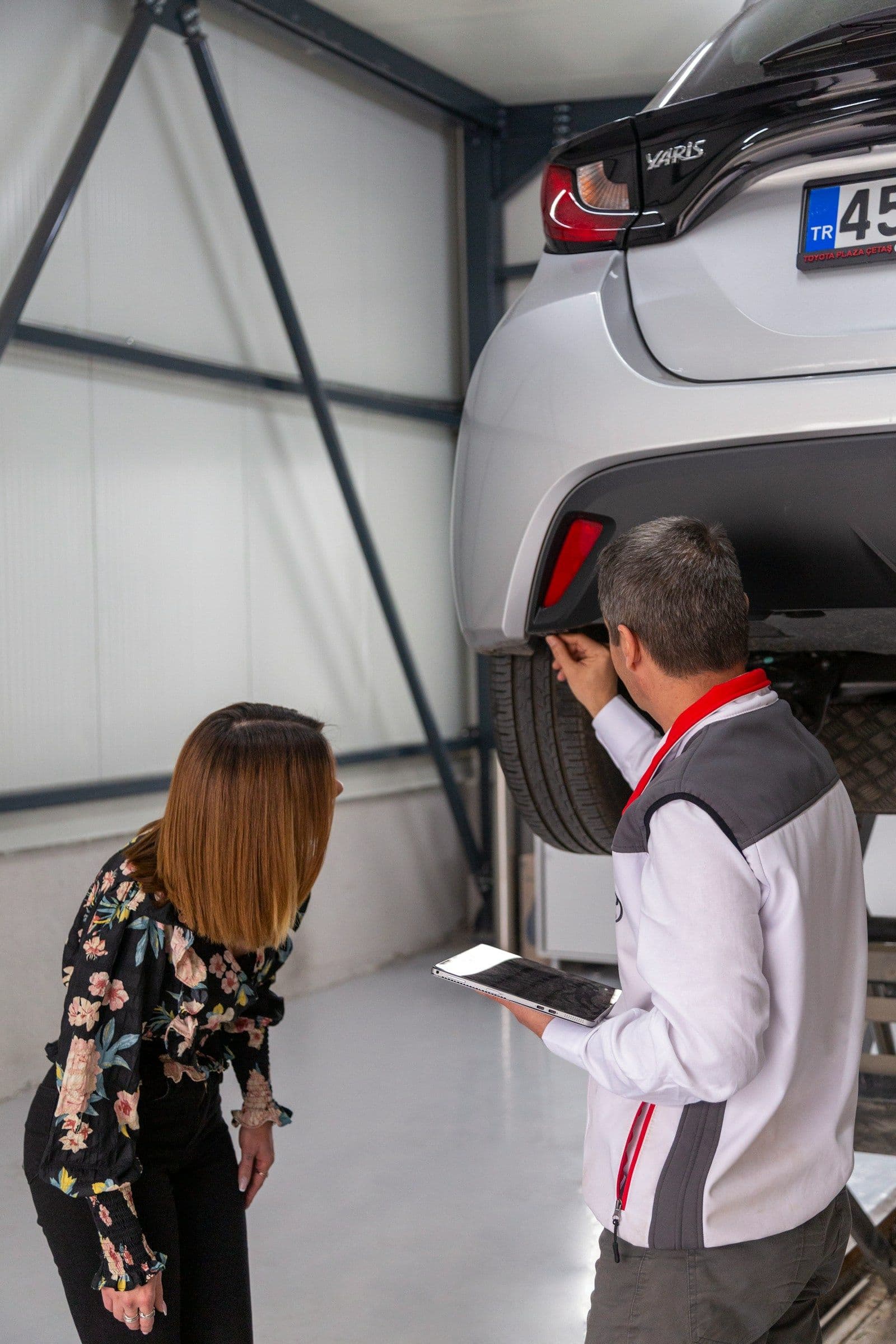
Frame straightening equipment usually clamps to the pinch welds under the rocker panels. Crushed, scarred or repainted pinch welds are a common sign that a vehicle was on a bench. Look at the rails behind the front bumper and in front of the rear wheels for wrinkles, heat discoloration, or fresh undercoating sprayed over one area only.
On the road, notice whether the vehicle pulls to one side, whether the steering wheel sits off-center when driving straight, and whether the tires are wearing unevenly. Any of these can come from structure that is out of position. They also come from worn suspension parts or a simple alignment problem, so treat them as a reason to have it checked.
What a pre-purchase inspection adds
The Federal Trade Commission advises paying for an independent inspection of a used car, and says it is a good idea even if the car has been “certified” and inspected by the dealer. It suggests asking the mechanic for a written report with a cost estimate for all necessary repairs, and considering another dealer if one will not allow an independent inspection.
For frame damage, choose an inspector with collision experience, such as a collision repair shop or a brand dealership with a body shop. Ask them to put the vehicle on a lift, check the rails, pinch welds and floor, take paint thickness readings, and write down any sign of structural repair they find. A general mechanical inspection may not include those checks unless you ask.
Reading a measuring printout
Shops check a body against the maker’s published dimensions with an electronic measuring system. The printout lists reference points on the underbody and in the engine bay, the specification for each, the measured value and the difference. A good set of records has two printouts: one taken before the repair, showing which points were out, and one after, showing every point inside the maker’s tolerance.
Only a pre-repair printout, or none at all, leaves a gap in the record. If you own the vehicle, ask the shop for both. If you are buying, ask the seller whether the repair paperwork came with the car.
Structural labor on the repair invoice
The invoice is the most direct evidence of what was done. These entries point to structural work:
- Setup and measure, or frame bench time.
- Pull, straighten or realign.
- Section, or partial replacement of a part.
- Part names such as rail, apron, strut tower, radiator support, pillar, rocker or floor pan.
- Pre-repair and post-repair scans.
Some structural work appears under other labels. Our article on frame labor relabeled on repair orders describes how that happens and what to ask.
What history reports can and cannot show
A report is only as complete as the data sent to it. The FTC puts it directly: a vehicle history report is not a substitute for an independent vehicle inspection, and while it may list accidents, it typically will not list mechanical problems. A collision paid for privately, with no insurance claim and no police report, may never reach a commercial report at all.
NMVTIS, the federal title database, holds title brands, odometer readings and insurer total-loss determinations, not repair history. It also warns that a search may return a false negative, such as no junk or salvage history, until every required entity is reporting. A report that mentions structural damage is worth taking seriously; one that does not is not a clean bill of health. How reports word structural entries is explained in how bad is frame damage?
If you find signs of structural repair
If you are buying, ask for the repair invoice, the measuring printouts and photos. Without them you are pricing an unknown, and the resale effect of an accident record will apply when you sell, too.
If you own the car, collect the final invoice with all supplements, both measuring printouts and the shop’s photos. If something looks wrong, our guide to safety after frame repair covers a second inspection. If another driver caused the collision, a frame-related diminished value appraisal is how structural repair is documented for a claim; see also our diminished value appraisal service. There is no charge for the claim review.
Common questions
Can you see frame damage just by looking at a car?
Sometimes. Uneven gaps, overspray and repair welds can be visible, but a well-finished structural repair may show nothing from outside. An inspection on a lift, paint readings and the repair paperwork are more reliable than a walk-around.
Does “no accidents reported” mean no frame damage?
No. History reports only list what was sent to them. A repair paid for without an insurance claim or police report can be missing, so an inspection is still worth paying for.
Who should inspect a used car for frame damage?
Someone with collision repair experience and access to a lift, such as a collision shop or a dealership with a body shop. Ask for the structural checks by name and for the findings in writing.
Keep reading
More from the damage type guide
Frame and structural damage
How bad is frame damage? What counts and how serious it is
Which parts are structural, a severity scale, and why buyers care.
Frame and structural damage
Is a car safe after frame repair? What a proper repair requires
Maker procedures, measurements, scans and the records that prove them.
Collision damage
Diminished value after a rear-end collision
Bumper-only repairs against rear body panel, trunk floor and rail work.
Collision damage
Diminished value after side-impact damage
Bolt-on doors against pillars, rocker panels and side airbags.

Not sure whether an appraisal will help?
The claim review is free: we look at your situation and tell you whether an appraisal is likely to help. The appraisal itself is a paid report. We help from start to finish, including a custom demand letter, and our support staff is a phone call away throughout the process.